Gift Program Budget Tiers: What $3, $8 and $20 Buy Per Unit
Three budgets decide three different gift programmes, and the mistake buyers make is treating them as the same programme at different prices. At $3 per unit the packaging is a cost problem, at $8 it is the reason the set exists, and at $20 the product has to survive being kept rather than used. The item that fills each tier changes accordingly, and so does the question you should be asking a supplier.
At $3, the box is the enemy
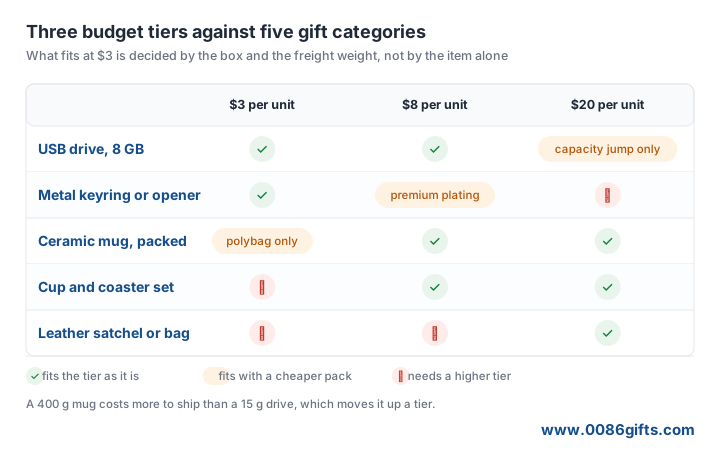
A three-dollar unit price leaves roughly forty to sixty cents for everything that is not the product, and a rigid box with a magnetic flap and a foam insert does not fit inside that number. This is the tier for polybag and header card, a printed sleeve, or a simple tuck-top carton. Items that work here are small, light and single-material: an 8GB USB drive, a metal keyring, a bottle opener, a lanyard, a notebook, a mouse pad, a basic ceramic mug.
Two numbers decide whether a candidate really fits. The first is weight, because freight is charged on it: a fifteen-gram flash drive and a four-hundred-gram mug are not in the same tier once the carton is on a plane. The second is the number of colours in the logo, because at this price a second print colour or a second print position is often the difference between a viable quote and a programme that gets cut in the last budget review.
What breaks at this tier is anything that needs an insert, a window, or a second material to look finished. A mug in a plain box reads as a cheap mug; the same mug in a printed sleeve with a matching coaster reads as a gift, and the coaster is what pushed it into the next tier.
At $8, the packaging starts earning its keep
Eight dollars is the band where a boxed set becomes sensible, because there is enough room for structure: a printed gift box, a moulded pulp or EVA insert that holds two or three components, and a ribbon or a belly band. That structure is not decoration; it is what allows a buyer to hand over one object instead of an assortment of loose items, and it is the single biggest perceived-value jump in the whole range.
The arithmetic to check before approving a design: ask for the box cost and the insert cost as separate lines, then compare them against the item cost. If the two together exceed the item, the programme is selling packaging, which can be a perfectly good decision for a client whose recipients will photograph the unboxing, and a bad one for a client handing gifts out at a trade show where the box goes in the bin within a minute.
Sets that work here usually share a material logic: a cup with a coaster in the same glaze family, a notebook with a pen in the same finish, a small speaker with a cable pouch. Mixed materials at this price tend to look assembled rather than designed, because each component gets its own finish and the finishes do not agree.

At $20, the product has to be worth keeping
Twenty dollars stops being about utility. At this level the recipient has usually owned the functional version of whatever you are giving, so the gift has to be better made, better finished, or in a category people collect: a leather satchel, a wine accessory set, a portable speaker, a porcelain dinner set, a fragrance diffuser set. The failure mode at this tier is a $20 item that looks like a $6 item in a nicer box, and recipients notice that faster than buyers expect.
What to inspect at this price is hand feel, not specification. Stitch density at the stress points on a bag, the weight of a metal buckle against its size, whether a lid closes with a damped action or a click, whether edges are painted or raw. These are the details that carry the tier, and they are all checkable on a single sample without a laboratory.
Where the money actually goes, and how to audit a quote
Every quote should decompose into five lines: product, decoration, packaging, carton and freight. Ask for them separately at the quotation stage, because a single unit price hides which line is carrying the margin and which line is being starved. The starved line is almost always packaging at the low tiers and decoration in the middle.
A useful cross-check is weight per unit shipped, not per unit produced. Divide the gross carton weight by the pieces inside, add the carton's volumetric weight if the freight is charged on volume, and compare that figure across two suppliers quoting the same item. A supplier whose unit price is ten cents lower but whose carton holds twenty-four pieces instead of thirty-six has not saved you ten cents; the freight difference usually exceeds it.
Test a tier on three units before committing
Order three samples, not one. Keep one sealed, open one and photograph it in the state a recipient would see, and give the third to someone in the office who does not know the price. Ask what they think it cost. If the guess lands two tiers below the actual budget, the problem is presentation rather than product, and no amount of extra decoration will fix a box that reads as an afterthought.
Then check the shipment arithmetic on the same three units: weigh the packed carton, measure it, and calculate cost per unit delivered rather than cost per unit produced. Programmes fail on that second number far more often than on the first, and it is the number the finance team will eventually ask for. Browsing the promotional gifts range with a target tier and a target weight in hand narrows the shortlist faster than starting from a catalogue and working out what each item would cost to ship.
Sourcing promotional gifts?
Send your item list and quantity for a quote and a digital proof.
Get a free quote


