Women Watch Movements: Quartz vs Automatic vs Solar at 500 Units
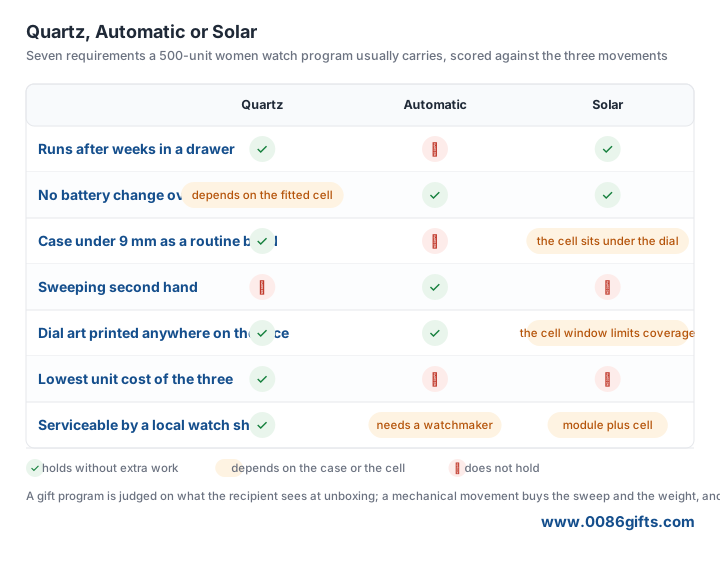
At 500 units, the movement question is not which technology is better. It is which technology survives the way a gift watch is actually used: worn daily for a month, then left in a drawer with the rest of the collection. That use pattern pushes most promotional orders to quartz, keeps automatic for the small share of programs where the gift has to feel mechanical, and puts solar in a narrow band where the dial can afford to lose design space.
Start From the Use Pattern, Not the Movement
Ask three questions before the movement is chosen. Will the watch be worn every day or handed out at an event and put away? Does the dial carry a printed logo or artwork that has to sit where the design says? Is the case height part of the brief, because a slim watch reads as a fashion piece and a thick one reads as a tool?
Those three answers eliminate one option almost every time. A watch that sits in a drawer for three weeks cannot be an automatic unless the recipient winds it, which most recipients will not do. A dial that has to carry artwork across its full width fights a solar cell. A case under 9 mm is routine in quartz and rare in automatic.
Quartz: The Baseline for Cost and Service
A quartz movement steps the second hand once per second and runs from a coin cell. That single fact produces the properties a gift program wants: the watch keeps time after months in a drawer, the case can be built thin, and a local watch shop can change the cell without a watchmaker. The cost of the movement is the lowest of the three, which matters at 500 pieces because the movement is a visible line in a quotation that buyers compare across suppliers.
The one thing to pin down in writing is the rated cell life, because it sets the service conversation. Ask for the figure from the movement supplier rather than from the trading company, and write it into the specification sheet with the cell type. A gift watch whose first battery dies inside the campaign window turns a branded present into a support request.
Automatic: What the Sweeping Hand Costs
An automatic movement converts wrist motion into a wound mainspring, and the second hand sweeps because the balance beats several times per second rather than once. That sweep, plus the weight of a rotor, is the whole reason to choose it: a recipient who notices watches will notice the difference, and a gift that feels mechanical carries a different kind of value than one that ticks.
The cost is mechanical and cannot be negotiated away. A rotor and a mainspring need space, so the case grows; a typical automatic build sits several millimetres taller than the same design in quartz. The watch also stops when it is not worn, so the recipient has to set it, which is a poor fit for a giveaway. And an automatic needs a watchmaker rather than a battery counter when it eventually needs service. None of these is a defect; they are the terms of the trade.
Solar: The Dial Becomes a Component
A solar watch puts a photovoltaic cell behind the dial and charges a rechargeable cell from ambient light. The appeal is obvious for a gift: no battery change during the campaign, and no winding. The constraint is the dial. Light has to reach the cell, so the dial is either translucent, perforated, or reduced in coverage, and that restricts where a logo or a printed pattern can sit.
Treat the dial as a component rather than a print surface from the first sketch. If the artwork needs full coverage, ask the supplier to show the cell geometry before the design is locked; a layout that ignores the cell window will be rejected at the sample stage, and the sample stage is where the calendar is cheapest to lose a week.
Where the Three Split at 500 Units
Five hundred pieces is a modest run, and modest runs punish anything that needs a new tool or a special order. Quartz movements are stocked in volume and can be swapped for a different calibre without touching the case in most designs. Automatic calibres are also stocked, but the case that holds one is a different case, so switching movements mid-project means a new case drawing and a new sample. Solar needs a dial built around the cell, which is a third design, not a variant.

What the Quotation Has to Separate
Ask for the movement, the case and the dial to be quoted as three lines rather than one unit price. When the three are mixed, a buyer comparing two suppliers cannot tell whether the difference is the calibre or the case finishing, and a late change of movement looks like a small adjustment when it is a new case.
Ask for the calibre reference as well, not just the word quartz or automatic. A calibre reference is what makes a replacement possible two years later, and it is the one item on the specification that a gift program cannot reconstruct from photographs.
Send us the dial artwork, the target case height and the campaign length, and we will tell you which of the three calibres fits before a sample is made.
Sourcing promotional gifts?
Send your item list and quantity for a quote and a digital proof.
Get a free quote


