Custom Wristwatch Bulk Order: 5 Movement and Case Specs
A wristwatch is the one gift in a corporate programme that people keep on their desk rather than in a drawer, which is exactly why it is also the item most likely to come back. The failure is rarely the design. It is a movement chosen by price, a case finished in a plating that wears through in a summer, or a water-resistance claim that was never true. Five specs decide whether a 1,000-piece watch order survives its first year on a wrist.
This guide is written for the buyer assembling a gift or promotional watch programme, where the order is large enough to matter and small enough that no one on your side is a watch specialist.

1. Movement: the one place not to save
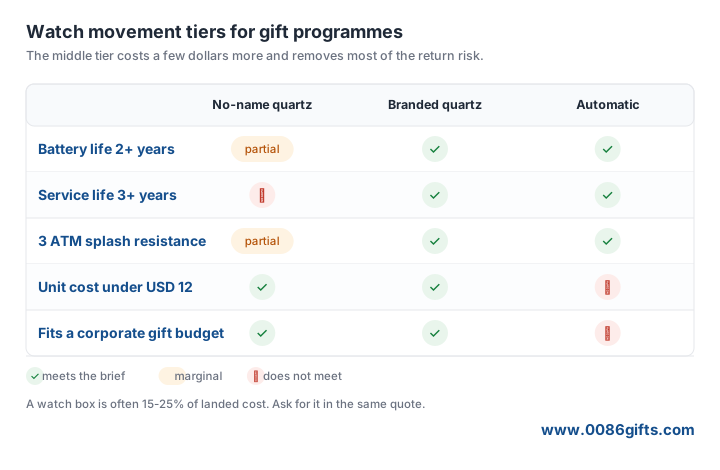
Three tiers exist in gift programmes. The cheapest is a no-name Chinese quartz at roughly one to two dollars, adequate for a single-event giveaway but with a noticeable failure rate after 18 months. The middle tier is a branded Japanese quartz such as a Miyota or equivalent, usually two to four dollars, with a service life measured in years and a battery life of two to three years. The top tier is an automatic or mechanical movement, which costs more than the rest of the watch combined and needs a buyer who understands what they are buying. For a corporate gift, the middle tier is almost always the right answer: the price difference is small at volume, and the perceived quality difference is large.
2. Case material and finish
Alloy cases dominate promotional watches because they are light and cheap to cast. They take plating well, but the plating is a surface, not the material, and it will wear at the crown and the case edges first. Stainless steel costs more and can be brushed or polished through, so wear does not expose a different colour underneath. If the programme runs for more than a year, or the watch will be worn daily, specify stainless. If it is a conference gift, alloy with a well-bonded plating is acceptable — but ask which plating process is used and whether it passed a salt-spray test.
3. Water resistance claims
3 ATM means splash resistant, nothing more. It does not mean swim-proof, and it certainly does not mean the watch can be worn in a shower. The number comes from a static pressure test on a sample, and it depends on the gasket, the caseback fit and the crown seal — all of which can vary between production lots. If your printed material claims water resistance, keep the wording to "3 ATM splash resistant" and nothing stronger. If the programme needs real water resistance, move to 5 ATM and expect a different case construction and a higher price.
4. Strap and buckle
Genuine leather, PU leather, silicone, and steel bracelets each carry a different cost and a different failure mode. PU delaminates at the lug ends where the strap flexes; genuine leather darkens and creases but holds. Silicone is the most durable and the least formal. Steel bracelets add weight and cost but avoid the strap problem entirely. Specify the lug width in millimetres, the strap thickness, and the buckle type. A pin buckle is standard; a deployment clasp is worth specifying if the watch is above a certain price point, because it removes the most common wear point on a leather strap.
5. Dial, hands and logo
Logo application drives both cost and the approval timeline. Pad printing on the dial is cheapest and works at small sizes; an applied metal logo reads as more expensive and needs a die. Embossing on the caseback is a good compromise — it is durable, it does not compete with the dial design, and it survives daily wear. Specify the logo size in millimetres, the position relative to the 12 o'clock marker, and the colour reference. Ask for a physical dial proof, not a digital mockup; pad-printed small text loses definition in a way a rendering never shows.
Getting the quote right
Send the factory five lines and you will get an accurate price the first time: movement tier, case material and plating, water resistance target, strap material and lug width, and logo method with size. Add the packaging — a watch box is often 15 to 25 percent of the landed cost and is frequently left out of the first quote, which makes comparisons between suppliers meaningless. Our men's watch range includes both leather-strap mechanical styles and lighter bracelet watches for volume gifting; both can be quoted against the same five-line brief so the comparison stays honest.
Sourcing promotional gifts?
Send your item list and quantity for a quote and a digital proof.
Get a free quote


