Leather Bracelet Edge Paint and Burnishing: 4 Finish Checks
On a leather bracelet, the edge is the part that touches the desk, the sleeve and the sweat, and it is the part nobody photographs. A sample with a beautifully matched face and a raw cut edge will look correct in a photo and feel wrong within a week of daily wear. Four checks settle the edge question in about ten minutes, and three of them need nothing more than your hands and a white cloth.
The Edge Is the First Thing a Wrist Wears Out
A bracelet strap bends at one place, every time it is put on and taken off, and the edge is where the bend starts. Leather face and leather core can both be good and the edge can still fail, because the edge is where the material has been cut and the fibres are exposed. Whatever finish is applied there has to do three jobs: seal the cut, match the face, and survive flexing without cracking.
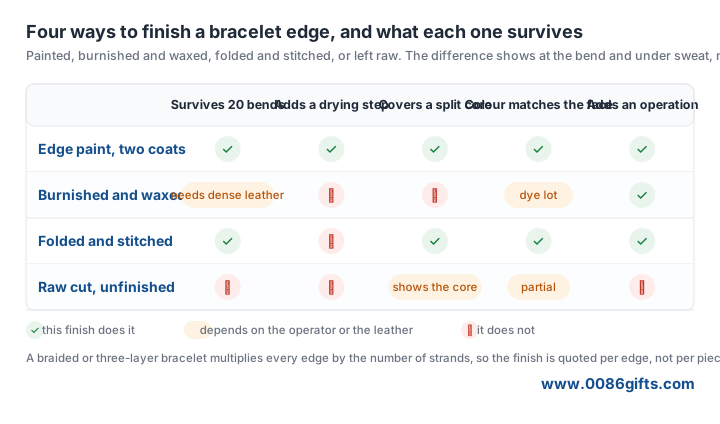
Four finishes cover almost every bracelet on the market. Edge paint is a coating, usually two coats with drying between them. Burnishing is friction and wax on dense leather, which closes the fibres instead of coating them. A folded and stitched edge hides the cut entirely inside a fold. A raw cut edge leaves the fibres open, which is a deliberate look on some rustic designs and an accident on most others.
Check 1: Coverage at the Cut Face
Hold the strap so the cut face is toward you and look at it at arm length, then close. What you want to see is an even band of colour with no lighter line where the leather core shows through. On a painted edge, a lighter line at the centre means the first coat was thin or the edge was not sanded before coating, and it will open at the first bend.
On a two-layer or three-layer bracelet the cut face is thicker, and the core is where a cheap strap hides. A split leather core bonded between two better layers looks fine on the face and shows clearly at the edge as a fibrous centre with a different texture. That is not automatically a defect, but it is a price difference, and the quote should say which core you are buying. Ask for the edge shot as part of the sample photos rather than accepting a face-on image.
Check 2: Twenty Bends at the Curve
Find the point where the strap naturally curves when worn, then flex it through its full range by hand twenty times, firmly enough that the edge compresses. Twenty is enough to open a coating that was applied too thick, and short enough that a buyer can do it on five samples in a few minutes.
Then look at the outside of the bend under a light held at a low angle. Cracking starts as a fine line parallel to the edge, not as a flake, and raking light is the only way to see it before it becomes visible at arm length. A painted edge that has cracked at twenty bends will crack in the field, and there is no repair short of re-cutting the strap. A burnished edge does not crack the same way, but it can go shiny and pale at the bend, which reads as wear.
Check 3: The White Cloth Test for Wax and Dye
Rub a white cloth firmly along the edge, then along the face, and look at the cloth rather than the bracelet. Wax from a burnished edge will leave a faint greasy mark, which is normal and stops after the first few wears. Dye transferring as a clear colour is a different matter: it means the finish is not fixed, and it will transfer to a shirt cuff.
This is also the check that connects to compliance. Dyed leather is where azo dye restrictions apply, and a finish that rubs off is the visible symptom of a dyeing process nobody tested. Ask for the test report on the dyed leather rather than on the finished bracelet, because the report follows the material, not the assembly.

Check 4: Colour Match and Build at the Edge
Compare the edge colour with the face colour in daylight, not under a desk lamp. A painted edge that is a shade darker reads as intentional; one that is a shade lighter reads as unfinished. Paint is matched by eye against a physical swatch, so ask for the swatch number in writing, because the next batch will be matched against the same number rather than against your memory.
Then check build. Two coats of paint add measurable thickness to the edge, and an edge that has been over-coated feels sharp against a fingertip while an under-coated one feels furry. Run a fingernail along the edge: a smooth, slightly rounded profile means the coats were sanded between applications, which is the step that gets skipped when a factory is busy.
Writing the Edge Spec Into the Order
The spec line needs four things: the finish by name, the number of coats or the burnishing method, the colour reference for the edge, and the acceptance rule from the bend test. Write the acceptance rule as a pass or fail rather than as a description, for example no visible cracking at the bend after twenty flexes. A description invites an argument; a pass or fail does not.
Ask for the edge shot in the sample photos and keep it with the order. When the bulk run arrives, photograph the same edge at the same magnification and compare the two side by side, because edge quality drifts with operator and with the age of the paint tin, and a single new photo always looks acceptable on its own.
Send us the bracelet design, the number of strands and the colour you need on the edge, and we will finish samples in paint and in burnished wax from the leather bracelet range so you can run the four checks before the bulk order.
Sourcing promotional gifts?
Send your item list and quantity for a quote and a digital proof.
Get a free quote


