Notebook Elastic Band and Ribbon: 4 Details Buyers Skip
The cover gets approved first and the elastic gets approved last, usually on the sample the day before the order is placed. Six months later the band hangs loose and the notebook will not stay shut in a bag, which is the moment a corporate buyer hears about it. Four details decide whether that happens: band width, elastic quality, how the band is fixed to the board, and the ribbon that hangs beside it.
Band Width and the Tension It Applies
A 10 mm flat band and a 6 mm round cord hold the same tension, but they spread it differently. The flat band presses on a wider strip of cover, so it marks a soft-touch laminate less and stays put when the book is slid into a bag. The round cord concentrates the same force on a narrow line, which is why it leaves a groove in a padded cover after a few months. For anything with a soft-touch or matt laminate finish, the flat band is the safer default; the cord belongs on slim, hard, uncoated covers.
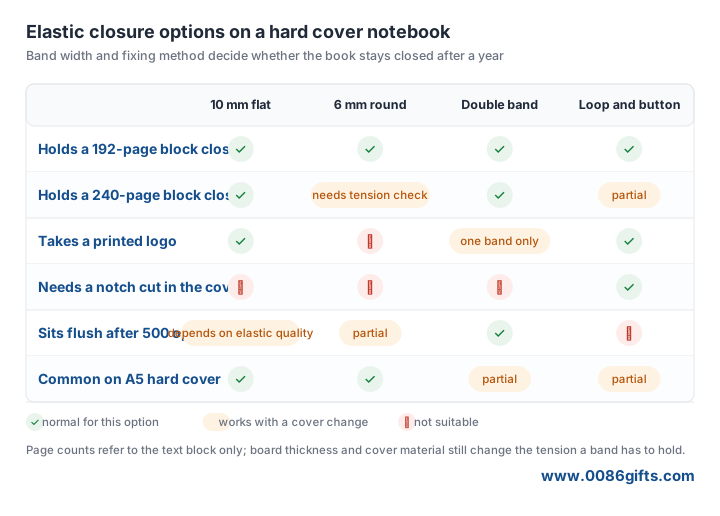
Tension is set by the band length relative to the closed book, not by the band thickness. The working rule is that the band should sit at roughly 10 to 15% stretch when closed. A band cut to the exact closed circumference has no grip; a band cut 25% short pulls the boards out of square and bows the cover, and the spine hinge takes the load every time the book is opened. Ask the supplier what stretch the band is cut to, and check it on the sample by marking 100 mm on the relaxed band and measuring again with the book closed.
Elastic Quality: The Detail That Decides Month Six
Two bands can look identical on day one and behave differently by month six. A band with a latex core recovers its length after stretching; a cheap band with a high filler content takes a permanent set, so the first month of use is the last month it holds the book closed. The test is simple and does not need equipment: stretch a 100 mm length to 150 mm, hold it for 24 hours, release it and measure again after an hour. A good band comes back to within 5 mm of the original; a poor one stays 10 to 15 mm longer and never recovers.

Colour fastness matters as much as elasticity when the band sits against a light cover. A dyed elastic that transfers colour leaves a stripe on a cream board within weeks. Ask for a transfer test: band and cover pressed together for 48 hours at 40 degrees, then check the cover for staining.
How the Band Is Fixed to the Board
Three fixing methods cover most hard cover notebooks. The band can be sewn into the back board before the cover is turned in, so the stitch is hidden under the liner; it can be glued between the board and the liner; or it can be riveted through the board with a metal eyelet. Sewn is the strongest for repeated opening because the load goes into the thread and the board, not into an adhesive line. Glued is the cheapest and the first to fail in a warm car, because the adhesive creeps. The riveted version looks deliberate and industrial but concentrates all the stress on one hole, and a torn eyelet cannot be repaired.
Whichever method is used, ask where the band enters the board. At the spine edge the band pulls against the hinge every time the book opens; 15 to 20 mm in from the spine edge, the pull lands on solid board. That shift costs nothing and roughly doubles the life of the closure.
The Ribbon: Length, Width and the Fraying Question
The ribbon is specified last and regretted first, because a ribbon that is too short is useless and one that is too long gets chewed at the fore edge. The working length is twice the page height plus 30 mm, so that when the book is closed and the ribbon is laid across the pages, the tail clears the fore edge by about 15 mm on both sides. A ribbon cut to exactly the page height disappears inside the book the first time it is used.
Width follows the book: 6 to 10 mm suits A5 and B5, 10 to 15 mm suits A4. Narrower ribbons curl and slip between pages; wider ones print the wrong side against the paper. Fixing matters more than width. A ribbon glued under the spine liner holds for a normal gifting life; a ribbon sewn into the spine binding survives daily use, which is what a diary or planner needs. Ask which one is being quoted, because both are called a ribbon bookmark on the sample sheet.
Ends fray unless they are finished. A heat-cut end seals the weave; a folded and stitched end is stronger but adds a step; a raw cut end will start to unravel after a few weeks of use and leave threads on the page. If the quote does not mention a finished end, assume it is raw.
What to Put on the Specification Sheet
Four lines cover the subject: band width and material with the cut stretch percentage, the recovery requirement from the 24-hour test, the fixing method with its distance from the spine edge, and the ribbon width, length and end finish. Add a photograph of the inside back board with the fixing visible, because that is the part nobody inspects and everybody notices when it fails.
On the sample, run the checks in the order that costs least: measure the band at rest and closed, stretch it for a day, check the cover for colour transfer, open and close the book 50 times and look at where the band enters the board, then pull the ribbon tail and see whether the end frays. Twenty minutes of work covers four details that decide whether the notebook is still usable at the end of the year.
Tell us the page count, cover material and quantity, and we will quote the band and ribbon to a stated stretch and fixing method rather than to a photograph. Browse the hard cover notebook range for the bodies these closures are built onto, then request a sample with the band specification written in.
Sourcing promotional gifts?
Send your item list and quantity for a quote and a digital proof.
Get a free quote


